.svg)




.jpg)


Every year on March 18th, Global Recycling Day prompts global industries to critically evaluate their circular economy strategies. For 2026, the official theme established by the Global Recycling Foundation is “Don't Think Waste — Think Opportunity”. While the commercial packaging sector has heavily invested in post-consumer recycled paper infrastructure to meet ESG targets, a critical and often misunderstood reality threatens the long-term sustainability of this model: the absolute physical limitations of paper fibers.
It is a pervasive industry misconception that paper products can be recycled indefinitely. In truth, the intensive mechanical and chemical processes of pulping, de-inking, and thermal drying fundamentally alter the substrate, shortening and weakening the cellulosic fibers during each pass through the system. A typical wood-based paper fiber can only withstand the recycling loop five to seven times before it degrades entirely, losing the tensile energy absorption and burst strength required for commercial applications. Consequently, the industry relies on a practice more accurately described as downcycling, where high-quality office grades are progressively converted into lower-tier packaging materials.
Without the continuous, daily introduction of fresh, virgin fibers into the global papermaking supply chain to reinforce these degrading networks, the world’s recycled paper supply would theoretically run out in a matter of months. This presents a severe paradox for procurement officers: maintaining a sustainable, high-quality recycled paper stream historically dictates the continuous harvesting of virgin timber. The pulp and paper industry currently accounts for up to 40% of all industrial wood traded globally, placing immense, unsustainable pressure on natural forest ecosystems and contributing to significant biodiversity loss.

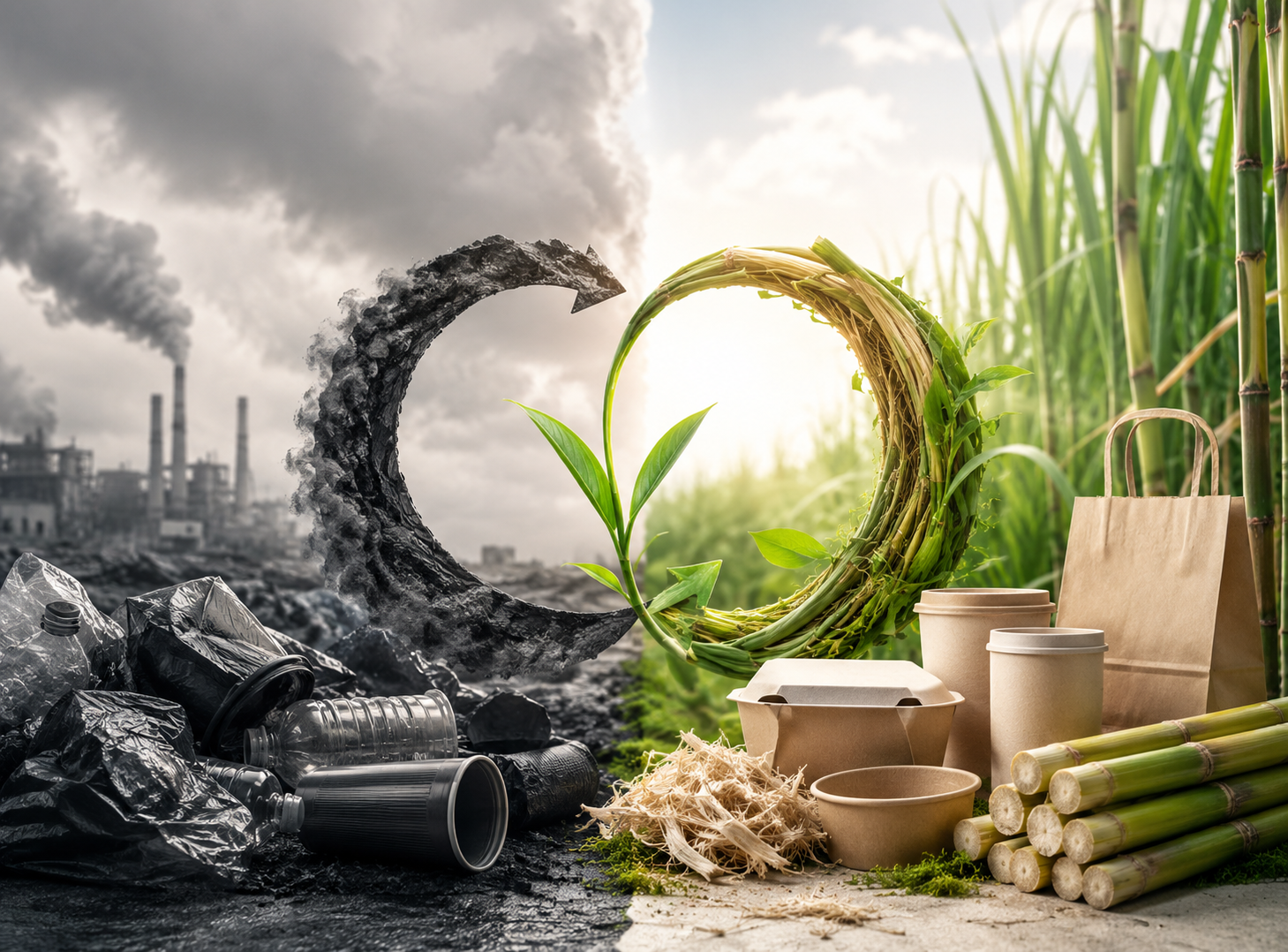
However, viewing agricultural waste as an "opportunity"—as this year’s theme demands—provides an elegant, scalable solution. Agricultural residues, particularly sugarcane bagasse, offer a high-quality virgin fiber source that requires zero deforestation. In agricultural hubs globally, millions of tonnes of crop residues are generated annually. In India alone, approximately 15.4 million tonnes of rice straw are burnt after harvests, releasing massive quantities of particulate matter and greenhouse gases.
By intercepting these residues and converting them into paper packaging, industries achieve a dual environmental victory. First, it mitigates the severe air pollution associated with open-field crop burning, which can elevate local PM2.5 concentrations to hazardous levels. Second, it provides the robust, virgin cellulosic fiber required to sustain the downcycling loop of the recycled paper industry. Bagasse fibers possess a length and chemical composition highly comparable to short-fiber hardwoods like eucalyptus, ensuring excellent formation, surface smoothness, and commercial printability.
For supply chain managers, relying solely on 100% recycled paper is no longer the ultimate benchmark of operational sustainability. A truly resilient procurement strategy recognizes that virgin fiber is a structural necessity, but dictates that this fiber should be sourced from a harvest's leftovers rather than a forest's canopy. Transitioning to agricultural waste ensures the circular economy remains ecologically viable for decades to come.
Photo by Sticker it on Unsplash
Photo by Trent Haddock on Unsplash